Step Into History
History in the Places Where It Happened
Some historical stories become far more powerful when you can enter the places where they unfolded.
Around Lake Balaton, remarkable buildings and hidden spaces preserve the traces of people whose lives were shaped by faith, conflict, ingenuity and changing times. Behind prison doors, inside an aristocratic library, among ancient rock-cut chambers or beside the machinery of a historic watermill, the past becomes something you can experience rather than simply read about.
Discover the prison that held famous historical figures, a library protected behind brick walls during the Second World War, the secluded homes of medieval hermits and a watermill where centuries-old engineering can still be seen at work.
Step Into History takes you beyond conventional sightseeing and into the original places where extraordinary stories unfolded.
Opening hours and guided visits may vary throughout the year. Always check the official websites for current visiting information before planning your trip.
Veszprém Castle Prison – Behind the Bars of History
In the heart of Veszprém's historic castle district stands a building that remained closed to the outside world for generations.
The Veszprém Castle Prison is far more than an old prison building. Its history reaches back to the seventeenth century, while the present five-storey complex dates from the nineteenth century. Remarkably, it continued operating as a prison until 2003.
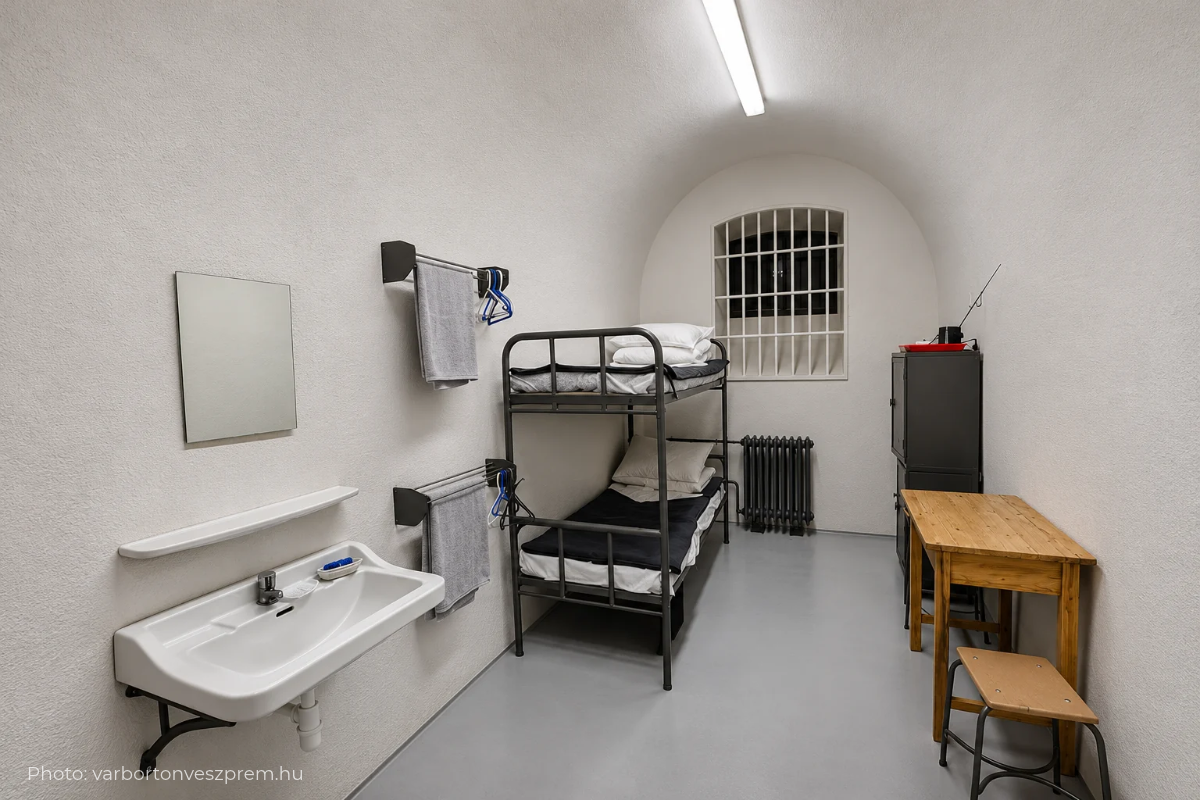
Today, visitors can enter spaces that were once part of everyday prison life and discover an unusually personal perspective on crime, punishment and justice.
The permanent exhibition, The Human Behind Bars, explores both the history of imprisonment and the lives of the people who passed through these walls.
Among the prison's best-known historical figures was József Mindszenty, who served as Bishop of Veszprém before becoming Archbishop of Esztergom. During his imprisonment, a small chapel was created for him inside the prison, where he was able to perform religious duties.
The exhibition also introduces visitors to the stories of famous Bakony outlaws, including Jóska Savanyú and Ferkó Milfajt, whose lives became part of the region's colourful criminal history.
But the most thought-provoking questions concern ordinary prisoners. What could they keep in their cells? How did they communicate with the outside world? What did a typical day look like, and how did imprisonment affect their lives?
Through original spaces, personal stories and interactive displays, the exhibition offers a rare opportunity to look beyond the prison bars and consider the people who lived behind them.
Check the official website for current opening hours, tickets and guided visiting options.
Festetics Palace – The Library Saved Behind Walls
Inside the magnificent Festetics Palace in Keszthely lies a historic library that survived one of the most destructive periods of European history thanks to an extraordinary decision.
The Helikon Library is the only aristocratic private library in Hungary to have survived with its original collection and furnishings intact.
Its story began in the eighteenth century, when Kristóf Festetics established a small book collection in the family palace. His descendants expanded it over generations, and between 1799 and 1801, György Festetics had the magnificent library wing created.
The richly decorated hall features two levels of bookshelves and galleries crafted from Slavonian oak by János Kerbl, a carpenter from Keszthely.
By the Second World War, the collection had grown to around 50,000 volumes.
Then came the moment that could have changed everything.
After Soviet troops occupied Keszthely on 30 March 1945, employees of the Festetics family appealed to the Soviet military commandant to protect the library. At their request, he ordered the entrances to the library and several neighbouring rooms to be sealed behind brick walls.
The unusual measure helped protect the collection from looting.
The library was not entirely untouched by the war: a shell entered through a window, destroyed a writing desk and damaged around thirty books with fragments. Nevertheless, the room and its remarkable collection survived.
Today, visitors can admire a historic interior that still preserves its original character.
Look closely at the bookshelves and you can even see the Latin classification labels introduced by György Festetics more than two centuries ago.
The collection now contains more than 86,000 items, including works in around thirty languages. Among its treasures is a copy of the Chronica Hungarorum, printed in 1488.
It is an extraordinary place where architectural beauty, centuries of learning and a remarkable wartime rescue story come together.
Check the palace's official website for current visiting arrangements and exhibition information.
Tihany Hermit Caves – Where Monks Lived Inside the Rock
Tihany is best known for its Benedictine abbey, but the peninsula also hides a much quieter chapter of religious history.
On the eastern slope of Óvár Hill, ancient chambers carved directly into the rock reveal the remains of a medieval hermit community.
Known locally as the Barátlakások, or Monk Houses, these remarkable spaces were created by Eastern Christian monks between the eleventh and fourteenth centuries.
The monks followed a monastic tradition in which individuals lived in separate cells while remaining part of a religious community.
What makes this site especially unusual is that the hermits did not simply build houses beside the hillside. They carved their living spaces directly into the rock.
The settlement included individual cells, a chapel and a shared dining room, offering a fascinating glimpse into the everyday organisation of medieval monastic life.
The surviving chambers are among the rare, relatively well-preserved examples of this type of hermit settlement in Central Europe.
Near the hermit caves lies another historical detail: the Ciprián Spring, formerly known as the Russian Well, which provided an important local source of water.
Today, a marked walking route leads visitors towards the rock-cut chambers through the peninsula's natural landscape.
Standing beside the entrances, it is possible to imagine the extraordinary simplicity of the lives once lived here — far removed from the busy streets of modern Tihany.
This is not a conventional museum visit, but an encounter with history in the landscape where it happened.
Before setting out, check the official local information and take suitable footwear for the walking route.
Kotsy Watermill – Where the Power of Water Comes to Life
In the village of Zalaszántó, a restored watermill offers a fascinating glimpse into a time when the movement of water powered everyday industry.
The Kotsy Watermill is named after a former owner, Nándor Kotsy, but the history of milling at this location goes back much further.
Historical records indicate that a watermill was already operating here during the period of Ottoman rule. By the nineteenth century, several water-powered mills were working in Zalaszántó, making milling an important part of local economic life.
The surviving building was constructed by János Major and later became associated with the Kotsy family.
Inside, visitors can discover a remarkable collection of historic milling equipment, including grain-cleaning machinery, grinding rollers, transmission systems and other devices once used to process grain.
One of the most impressive features is the waterwheel, measuring 3.9 metres in diameter. Water flows onto the wheel from above, turning it and demonstrating how flowing water can be converted into mechanical energy.
The history of the mill also reflects the changing technologies of the twentieth century.
Although the building was reconstructed in the 1950s, plans to modernise its milling equipment were never fully realised. Over time, water power was replaced by engine-driven and later electric machinery, before commercial grinding eventually ceased.
The mill was subsequently restored and preserved as a heritage attraction by the Balaton Uplands National Park Directorate.
Today, visitors can discover the machinery and, when demonstrations are operating, see the historic waterwheel turn once again.
It is a rare opportunity to understand traditional engineering through the movement of the machines themselves rather than through photographs or diagrams.
The mill has seasonal and group-visiting arrangements. Check the national park's official website for current opening hours and advance booking requirements.